
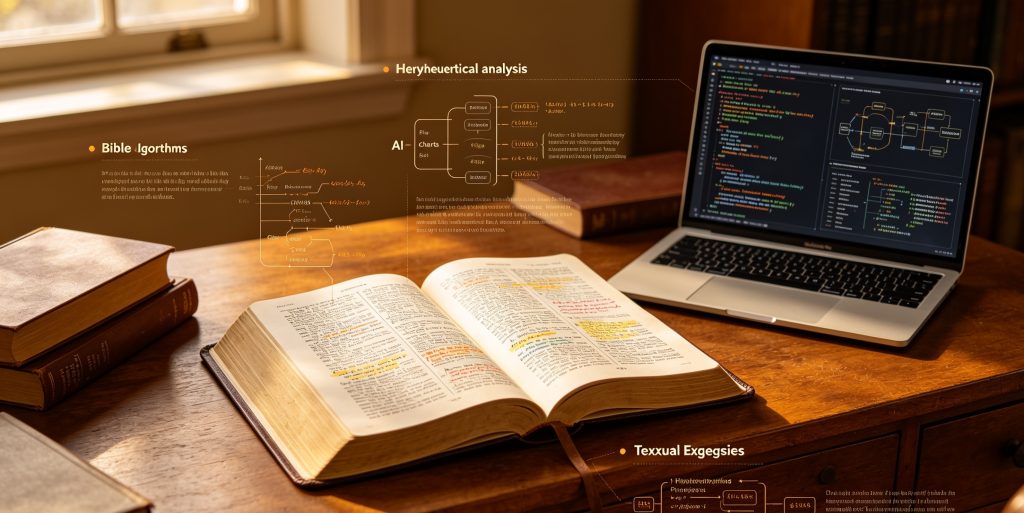
My primary law of Hermeneutics is “Scripture interprets Scripture”
-Jerry Riggin, May 2026
Standard Disclaimer: Don’t believe anything AI (or I) say. Be a Berean (Acts 17:11) and study the scripture to see if it is true. I don’t want to get in trouble. See James 3:1 and Revelation 22:18-19.
The following is edited by me and uses information produced by Grok AI in my project “Bible Study” which has these primary instructions/guard rails:
“Use only biblical sources and reliable Christian commentary by authors like John Macarthur, Chuck Missler, Mark Correll, John Lennox, Allen Nolan, Chuck Smith and other Calvary Chapel teachers. Use commentaries by Jamieson Fausset and Brown (JFB) Critical and Experimental Commentary, Keil and Delitzsch Commentary on the Old Testament, The Pulpit Commentary as edited by H.D.M. Spence and Joseph S. Exell, Matthew Poole’s Annotations and John Gill’s Exposition. Always note discrepancies between authors you use and any divergence from their teachings and the bible itself. For the Old Testament, reference the Septuagint and note discrepancies between the Septuagint and Masoretic texts. In the New Testament, note any difference between Textus Receptus, Critical Text and Majority Text. You may use Josephus and verified historical and archaeological findings, including geographical, political and societal findings relevant to the time period of the question, but only when asked to do so. You may also use observational science, but never consensus science, across any discipline when asked to do so.”
Hermeneutics is the science (or systematic methodology) of interpreting text like the Bible—specifically, the principles and rules for discovering the God-given meaning in Scripture rather than imposing our own ideas onto it.
The English word comes directly from the biblical Greek verb hermēneuō (ἑρμηνεύω), which means “to interpret, translate, or give the sense/meaning.” This same word appears in Luke 24:27, where the risen Lord Jesus “beginning at Moses and all the prophets… expounded [hermēneuō] unto them in all the scriptures the things concerning himself.” In that encounter on the Emmaus road, Christ Himself modeled hermeneutics by drawing the true meaning out of the Old Testament (referencing the Septuagint text used by the early church) and showing its Christ-centered intent.
John MacArthur defines it this way: “Hermeneutics is the science of Bible interpretation… It operates under fixed rules. That is the crucial science behind all accurate doctrine, all sound doctrine that is faithful to the Word of God.” He stresses that the interpreter’s task is exegesis (to “lead out” the meaning already present in the text) rather than eisegesis (reading one’s own meaning into the text). Proper hermeneutics begins with the conviction that God communicated clearly and intentionally through human authors in their historical, grammatical, and literary context.
Chuck Missler similarly describes hermeneutics as “your theory of interpretation,” emphasizing a literal approach wherever the plain sense makes sense, while always letting Scripture interpret Scripture. He notes that our worldview and presuppositions inevitably shape how we read, but faithful hermeneutics guards against those biases by anchoring everything to the text itself.
Calvary Chapel teachers (led by Chuck Smith and others) do not often use the technical term “hermeneutics,” but their entire philosophy of ministry rests on it. They practice verse-by-verse, expository teaching—reading the Word, “giving the sense,” and causing the people to understand the meaning (echoing Nehemiah 8:8). This is exactly what the Bible calls the gift of “interpretation” (hermēneia) in 1 Corinthians 12:10 and 14:26. Their distinctive is the grammatical-historical, literal method: “If the plain sense makes sense, seek no other sense, lest it be nonsense.”
Biblical foundation (all authors cited above are in full agreement here):
- 2 Timothy 2:15 – “Study to shew thyself approved unto God, a workman that needeth not to be ashamed, rightly dividing the word of truth.”
- 2 Peter 1:20-21 – “No prophecy of the scripture is of any private interpretation… holy men of God spake as they were moved by the Holy Ghost.”
- Nehemiah 8:8 – The Levites “read in the book of the law of God distinctly, and gave the sense, and caused them to understand the reading.”
No discrepancies exist among MacArthur, Missler, Smith, or the other Calvary Chapel teachers referenced in the query. All teach the same conservative, evangelical hermeneutic: literal where the text is literal, figurative where the text is figurative, always grammatical-historical, always letting Scripture be its own best interpreter, and always submissive to the Holy Spirit who inspired the text. None diverge from the Bible’s own model of interpretation demonstrated by Jesus and the apostles. This approach stands in contrast to allegorical or subjective methods that have arisen in church history, but those are not represented by the authors you specified.
In short, hermeneutics is not an optional academic exercise—it is the indispensable skill every believer must cultivate to “rightly divide” God’s Word and hear His voice clearly.
God knew Us Before the Beginning of Time
The Bible teaches that God knew, chose, and set His purposes for His people before the foundation of the world (or “before the beginning of time”/“before the ages began”). This theme appears in several key New Testament passages emphasizing God’s eternal foreknowledge, election, and grace, as well as in Old Testament examples of His intimate pre-birth knowledge of individuals. Below are the primary verses (quoted from the King James Version for consistency with many of the referenced teachers).
Primary New Testament Verses
- Ephesians 1:4 (and context vv. 3–6): “According as he hath chosen us in him before the foundation of the world, that we should be holy and without blame before him in love: Having predestinated us unto the adoption of children by Jesus Christ to himself, according to the good pleasure of his will…” This is the clearest statement that God chose us in Christ before creation itself.
- 2 Timothy 1:9: “Who hath saved us, and called us with an holy calling, not according to our works, but according to his own purpose and grace, which was given us in Christ Jesus before the world began.”
- Titus 1:2: “In hope of eternal life, which God, that cannot lie, promised before the world began.” (This highlights the eternal promise rooted in God’s pre-temporal plan.)
- Romans 8:29: “For whom he did foreknow, he also did predestinate to be conformed to the image of his Son…”
- 1 Peter 1:2: “Elect according to the foreknowledge of God the Father…”
These verses collectively show God’s knowledge and choice of believers (and His redemptive plan) existed before time—not based on human merit or works, but on His sovereign purpose and foreknowledge.
Old Testament Illustrations (Pre-Birth Knowledge as a Picture of God’s Eternal Awareness)
- Jeremiah 1:5: “Before I formed thee in the belly I knew thee; and before thou camest forth out of the womb I sanctified thee, and I ordained thee a prophet unto the nations.” This is specific to Jeremiah’s calling but is often cited as illustrating God’s personal foreknowledge of individuals. In the Septuagint (LXX, Brenton’s translation): “Before I formed thee in the belly, I knew thee; and before thou camest forth from the womb, I sanctified thee; I appointed thee a prophet to the nations.” This matches the Masoretic Text (MT) almost verbatim here—no significant discrepancy in wording for this verse, though the book of Jeremiah as a whole is notably shorter in the LXX than in the MT.
- Psalm 139:13–16 (esp. v. 16): “Thine eyes did see my substance, yet being unperfect; and in thy book all my members were written, which in continuance were fashioned, when as yet there was none of them.” This emphasizes God seeing and ordaining the psalmist’s life before physical formation. In the Septuagint (LXX, Brenton’s translation): “Thine eyes saw my unwrought substance, and all men shall be written in thy book; they shall be formed by day, though there should for a time be no one among them.” Note on discrepancy: The LXX has a slightly broader, more universal tone (“all men shall be written…”), while the Masoretic Text is more personal (“all my members were written…”). Both affirm God’s pre-formation knowledge, but the LXX reading can sound more general about humanity’s days being recorded.
Reliable Christian Commentaries (per your specified sources)
These teachers consistently highlight God’s eternal initiative and grace:
- John MacArthur (Grace to You) teaches unconditional sovereign election: God chose us “in Christ before the foundation of the world… completely apart from any merit or deserving.” He stresses this was “before the creation, the Fall, the covenants, or the law,” establishing an eternal union with Christ. On Romans 8:29 and 2 Timothy 1:9, he sees foreknowledge as God’s relational, loving choice, not mere foresight of human faith. MacArthur’s view is strongly Calvinistic/unconditional.
- Chuck Smith (Calvary Chapel founder) affirms: “God chose me before the foundations of the world… according to His foreknowledge. Because God knows all things, He will never learn anything new.” He links Ephesians 1:4 and 2 Timothy 1:9 to God’s eternal purpose and grace (not works), thrilling in the fact that God chose us before we existed or “cleaned up our act.” Calvary Chapel generally holds election based on foreknowledge (God knew who would respond in faith), balancing sovereignty with human responsibility/free will.
- Chuck Missler (often associated with Calvary Chapel teaching) echoes the eternal timing: “He has chosen us… before the foundation of the world!” He quotes Spurgeon approvingly (“I’m glad He did it then; if He saw me now, He might have changed His mind”) and presents election, predestination, and foreknowledge as profound doctrines of God’s sovereign, pre-temporal plan in Ephesians.
Note on discrepancies among authors and with Scripture: MacArthur emphasizes unconditional election (God’s choice is not based on foreseen faith). Smith (and Calvary Chapel broadly) teaches election according to foreknowledge (conditional on God’s perfect knowledge of who would believe). Missler focuses more on the awe-inspiring sovereignty and timing without resolving the debate explicitly. The Bible itself uses both “chose… before the foundation of the world” (Eph 1:4) and “foreknow” (Rom 8:29; 1 Pet 1:2), so both perspectives find support in the text. All three teachers (and the others you listed—e.g., Allen Nolan, Mark Correll) agree on the core truth: God’s knowledge and gracious purpose for His people existed before time began, rooted entirely in His initiative, not human effort. No author diverges from the plain biblical statements that this was “before the world began.”
These truths should humble and comfort us—our salvation was never an afterthought but part of God’s eternal plan in Christ.